Name: 
REN Wei
Title ( post ): 
Professor & Assistant Dean (Research)
Department: 
Mechanical and Automation Engineering
email: 
renwei [at] mae.cuhk.edu.hk
phone: 
3943 9486
website: 
https://www4.mae.cuhk.edu.hk/peoples/ren-wei/
Area of expertise: 
Combustion and fuels, Optical diagnostics, Spectroscopic instrumentation
Avatar: 
Class: 
faculty_member
Chinese Name: 
任偉
glossary_index: 
R
Name: 
LU Yi Chun
Title ( post ): 
Department Vice-Chairman (Graduate) and Professor
Department: 
Mechanical and Automation Engineering
email: 
yichunlu [at] mae.cuhk.edu.hk
phone: 
3943 8339
website: 
https://www4.mae.cuhk.edu.hk/peoples/lu-yi-chun/
Area of expertise: 
Electrochemistry, charge transfer and transport kinetics, electrocatalysis, solid-state chemistry, materials synthesis and chemistry by design
Avatar: 
Class: 
faculty_member
Chinese Name: 
盧怡君
glossary_index: 
L
Research Area: 
Electrochemistry, Batteries, Fuel Cells, Electrochemical Energy Storage and Conversion
Name: 
LIU Yun Hui
Title ( post ): 
Choh-Ming Li Professor of MAE
Department: 
Mechanical and Automation Engineering
email: 
yhliu [at] mae.cuhk.edu.hk
phone: 
3943 8340
website: 
https://www4.mae.cuhk.edu.hk/peoples/liu-yun-hui/
Area of expertise: 
Medical robotics, biomedical sensors and systems, vision-based control of robotic systems, aerial robots, mobile robotics, mutli-fingered grasping.
Avatar: 
Class: 
faculty_member
Chinese Name: 
劉雲輝
glossary_index: 
L
Research Area: 
Aerial Robots
Name: 
LIAO Wei Hsin
Title ( post ): 
Choh-Ming Li Professor of Mechanical and Automation Engineering
Department: 
Mechanical and Automation Engineering
email: 
whliao [at] mae.cuhk.edu.hk
phone: 
3943 8341
website: 
https://www4.mae.cuhk.edu.hk/peoples/liao-wei-hsin/
Area of expertise: 
Smart Materials and Structures, Energy Harvesting, Vibration Control, Mechatronics, Precision Machinery, Nanotechnology, and Medical Devices
Avatar: 
Class: 
faculty_member
Chinese Name: 
廖維新
glossary_index: 
L
Research Area: 
Energy, Vibration, Mechatronics, Exoskeleton, Smart Structures
Name: 
CHEN Shih Chi
Title ( post ): 
Professor
Department: 
Mechanical and Automation Engineering
email: 
scchen [at] mae.cuhk.edu.hk
phone: 
3943 4136
website: 
https://www4.mae.cuhk.edu.hk/peoples/chen-shih-chi-2/
Area of expertise: 
Machine design, Manufacturing, MEMS, Microscopy
Avatar: 
Class: 
faculty_member
Chinese Name: 
陳世祈
glossary_index: 
C
Research Area: 
Machine design, Manufacturing, MEMS, Microscopy
Name: 
HUANG Jie
Title ( post ): 
Choh‐Ming Li Research Professor of MAE and Associate Dean (Research)
Department: 
Mechanical and Automation Engineering
email: 
jhuang [at] mae.cuhk.edu.hk
phone: 
3943 4227
website: 
https://www4.mae.cuhk.edu.hk/peoples/huang-jie/
Area of expertise: 
Systems and Control, Guidance and Flight Control
Avatar: 
Class: 
faculty_member
Chinese Name: 
黃捷
glossary_index: 
H
Research Area: 
Systems and Control, Guidance and Flight Control
Name: 
ZHANG Yingjun Angela
Title ( post ): 
Professor
Department: 
Information Engineering
email: 
yjzhang [at] ie.cuhk.edu.hk
phone: 
3943 8465
website: 
http://www.ie.cuhk.edu.hk/people/yjzhang.shtml
Area of expertise: 
Wireless Communications and Networking
Avatar: 
Class: 
faculty_member
Chinese Name: 
張穎珺
glossary_index: 
Z
Research Area: 
Wireless Communication, Network Economics

CUHK Develops Novel Tree Guard Monitoring System to Safeguard Invaluable Trees and Monitor Collapse Risk

Date: 
2014-10-28
Thumbnail: 
Body: 

Two professors of The Chinese University of Hong Kong (CUHK), Prof. CHIU Siu Wai, School of Life Sciences and Prof. CHENG Chun Hung, Department of Systems Engineering and Engineering Management, have jointly developed an innovative ‘Tree Guard Monitoring System’, with a sponsorship from the Chung Chi College. The automatic monitoring system allows round-the-clock surveillance against possible tree theft, as well as risk of collapse for tilt and sick trees.  The system can be adopted by country parks, property managements as well as garden managements.  The novel system will be exhibited at the InnoCarnival 2014 to be held next month. 

As early as the Song Dynasty, farmers in Hong Kong planted Incense trees for producing and exporting fragrant products. The precious Incense trees have been in high demand, especially among the illegal traffickers in the mainland.  The endangered and vulnerable Incense trees are conserved by The State Council of China as a national protection wild plant (second class).  In Hong Kong, thefts of Incense trees, as well as the Buddhist Pine, another precious species known as the ‘Fung Shui’ tree, have been very frequent recently.  The incidents have prompted Prof. CHIU Siu Wai and Prof. CHENG Chun Hung, with a team of CUHK students and staff (including Mr. Stanley LO and Mr. Sam HUNG from the Department of Systems Engineering and Engineering Management), to develop the novel ‘Tree Guard Monitoring System’ to protect the plants, as well as to monitor the collapse risk of hazardous trees. 

The ‘Tree Guard Monitoring System’ consists of multiple sensors, such as sonic, temperature, humidity and tilt sensors, which are integrated into a hardware device with wireless communication capabilities for continuous monitoring. When the device is mounted on the tree, alerts will be sent to the control room when abnormal activities on the trees, such as sawing and hammering are identified. The same principles can be applied to monitoring tilt and sick trees.  

The natural environment is complicated and ever changing. For instance, a storm may destroy the devices, and minor movement may trigger the alarm system.  Therefore it is a great challenge for the researchers to develop a robust system with the least chance of false alarms.  Nonetheless, Mr. Lo and Mr. Hung insisted on carrying on the research and development of the system. 

Prof. CHENG Chun Hung explains, ‘The “Tree Guard Monitoring System” utilizes various wireless technologies to form a scalable wireless mesh network for transmitting sensor data to the control center.  The wireless communication network can be scaled up for wider coverage in two dimensions: 1) expansion within a tree group with  low-bandwidth, low-energy wireless communication; and 2) extending the coverage in multiple tree groups with Wi-Fi network communication, which should be readily available in many private premises and government facilities.’ 

Prof. CHIU Siu Wai said, ‘The system can provide useful real-time data for the tree management teams to devise proactive and reactive measures for safeguarding trees. In future, we also hope to set an early warning mechanism for trees with collapse risk, so that preventive measures can be carried out as early as possible to avoid accidents and casualties.’ 

Albeit difficult, Professor Chiu and Prof. Cheng still deemed it worthwhile to develop the system for protecting the trees and people’s lives. CUHK has been actively undertaking tree management research and offering recommendations to the authorities.  In October 2010, Prof. CHIU Siu Wai urged the government to formulate a sustainable tree strategy and establish a tree health database in Hong Kong to improve the effectiveness of tree management.  She has developed two novel tree management skills—‘paint coating’ and ‘micro-drill sampling’, which can help prevent trees from dying due to pest infestations, prevent Incense trees from producing resin, as well as detect hidden tree diseases and structural defect at an early stage.  Professor Chiu has held five different ‘Tree pests and treatment workshops’, in which various experts introduced common tree diseases, controlling strategies for sick trees, and shared tree management experience. Participants could learn and practise on-site during the workshop.

CUHK’s participation in InnoCarnival 2014

CUHK will participate in the InnoCarnival 2014, organized by the Innovation and Technology Commission of the Hong Kong Special Administrative Region Government, from 1 to 9 November at the Hong Kong Science Park.  Eighteen innovative projects developed by CUHK researchers will be showcased to inspire youngsters’ interest in science, engineering and mathematics.

Members of the public are welcome to visit CUHK’s booth at the InnoCarnival 2014, to learn more about the Tree Guard Monitoring technology and other recent innovative projects. Interactive games are also available to deepen visitors’ knowledge of the showcased projects.

Date: 

1 to 9 November 2014

Time:

10:00 am to 7:00 pm

Venue:

Convention Centre 3, 1/F., 12W, Phase 3, Hong Kong Science Park, Sha Tin

Website of InnoCarnival 2014: http://www.itm.gov.hk/

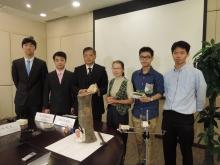
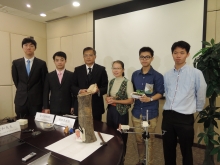
The research team led by Prof. CHIU Siu Wai (3rd right), School of Life Sciences, and Prof. CHENG Chun Hung (3rd left), Department of Systems Engineering and Engineering Management, has jointly developed an innovative ‘Tree Guard Monitoring System’.


The ‘Tree Guard Monitoring System’ allows round-the-clock surveillance against possible tree theft, as well as risk of collapse for tilt and sick trees.


CUHK Develops Novel Tree Guard Monitoring System to Safeguard Invaluable Trees and Monitor Collapse Risk

Alumnus Tak-Sing Wong Named One of the World's Top 35 Innovators

Date: 
2014-09-17
Thumbnail: 
Body: 

Carnivorous plant inspires solution to “sticky” problems

The distinguished alumnus from Department of Mechanical and Automation Engineering was recently been selected as one of the world's top 35 innovators under 35 by MIT Technology Review in recognition of his achievement in inventing one of today’s most intriguing and potentially useful new materials. Called SLIPS, for “slippery liquid–infused porous surface,” it repels any type of liquid, from oil to water to blood, and prevents organisms like bacteria and barnacles from sticking.

The range of possible applications for the new material is wide: it could be used to coat medical devices such as catheters to decrease the potential for bacterial contamination or cover the hull of a ship to prevent barnacles from adhering to the surface.

Working at the Wyss Institute for Biologically Inspired Engineering at Harvard University, Wong modeled the SLIPS material after the carnivorous pitcher plants Nepenthes, which produce a surface that can upend even the oily feet of an ant and send the bug hydroplaning into the stomach of the plant. He assembled micro- and nanoscale structures and filled the empty spaces within the structures with a lubricant that repels both liquids and solids, including ice and bacterial biofilm.

He is now an assistant professor of mechanical engineering at Pennsylvania State University.

From www.technologyreview.com/lists/innovators-under-35/2014/


Filter: Dept: 
Faculty
MAE

Pages