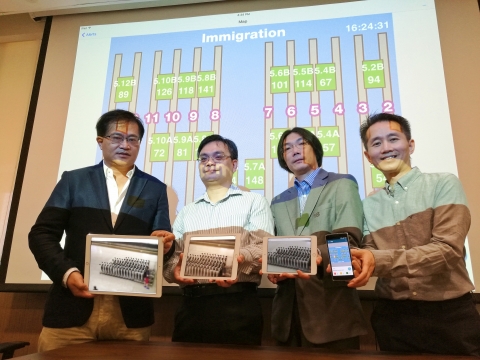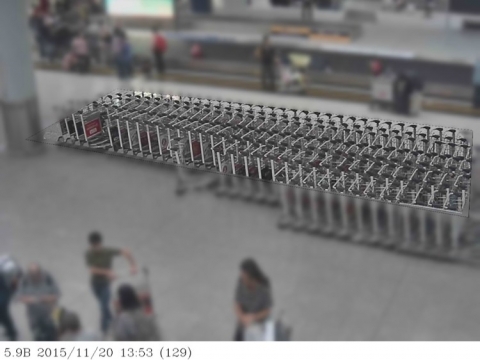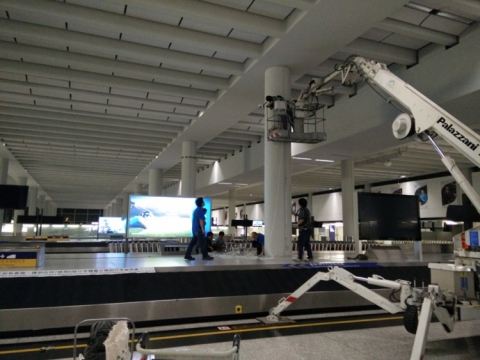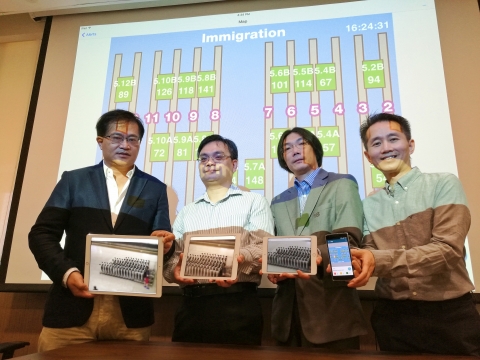
The Department of Systems Engineering and Engineering Management, in collaboration with Hong Kong R&D Centre for Logistics and Supply Chain Management Enabling Technologies (LSCM R&D Centre) and Airport Authority Hong Kong (AA), has successfully developed a Real-time Trolley Supply Monitoring System at the Hong Kong International Airport (HKIA) with the use of artificial intelligence techniques for analysing video content. The system has reached an accuracy of 92%, enabling frontline staff to make proper and timely allocation of trolleys for passengers. The research is supported by the Innovation and Technology Fund. HKIA serves over 70.5 million travelers in 2016 and handles over 1,100 flights daily. Around 13,000 baggage trolleys are distributed throughout the airport to cope with the enormous passenger flow, and maintaining a steady supply of trolleys has been one of the major concerns of HKIA. The CUHK team led by Prof. Cheng Chun-hung, Department of Systems Engineering and Engineering Management has collaborated with HKIA in estimating the baggage trolley availability at various trolley racks or pick-up points through machine learning techniques, image-based technologies and existing surveillance CCTV cameras, since 2014. The Real-time Trolley Supply Monitoring System, which can be connected to iOS and Android apps, enables frontline service providers and management to monitor trolley availability at all pick-up points. Different signals represent different levels of availability: yellow alert for quantity dropping down to 50 or below, red alert for empty racks and green alert for normal supply of more than 50. The system makes resources allocation more flexible and efficient, and thereby improves the passenger’s experience. Low installation cost, high service efficiency The CUHK team has put a lot of effort into enhancing the ease of system deployment and reducing the challenges that may arise. Prof. Cheng Chun Hung said, ‘By using machine learning techniques such as support vector machines and neural networks, we are able to use video data to build trolley detectors that can identify four different types of trolley and conduct the smart counting. Thanks to HKIA for providing the testing site and solid support, the detection rate of the system has increased from 87% to 92%.’ ‘A camera network infrastructure normally incur high installation cost which covers building, cabling and engineering works. To minimize costs, our team has devised a data network with edge processing capability to eliminate the need of high bandwidth video transfer while at the same time, maintaining the image quality and data quantity,’ said Prof. Cheng Chun Hung. Mr. Chris AuYoung, General Manager, Smart Airport of the AA said, ‘HKIA strives to develop into a smart airport. Through the application of intelligent data and automation technologies, we hope HKIA can become more efficient, convenient, and enhance the airport experience for our passengers. This is a good example illustrating our successful collaboration with the local research and development institutions and universities. This baggage trolley tracking system not only greatly reduces the need for manual checking of the trolleys, but also helps our service provider to replenish the trolleys at specific locations at a timely manner. As a result, the service level of trolley availability for passengers in the baggage reclaim hall has been improved, which helps us provide a pleasant airport experience to our worldwide passengers.; He added, ‘Since trolley management is a common challenge for most of the airports in the world, there would be a good opportunity to export such a solution and Hong Kong International Airport would be a good showcase to illustrate the business benefits’, he added. Mr. Simon Wong, Chief Executive Officer of the LSCM R&D Centre, said, ‘We are delighted that academics and industry can utilize the funding support from the Innovation and Technology Fund for enabling research, so that technology is deployed more commonly and effectively for our daily living. We hope that this technology will be extended to other areas for a wider application.’ Facilitating long term planning and ensuring security ‘The research project has facilitated the resource and service management at HKIA because the frontline staff can now perform timely trolley replenishment. In addition, the system is able to support data-oriented analysis and even big data analysis for a range of long term resource planning as it continuously collects operational data on trolley usage and replenishment’, said Dorbin Ng, a member of the research team. Tim Chan, also a member of the research team said, ‘Currently, 18 video cameras have been placed in the Baggage Reclaim Hall for monitoring trolley availability. Regarding passenger privacy issue, we have repeatedly worked with HKIA to define the most appropriate video monitoring areas. The system is also able to automatically blur visual contents other than the trolley racks. All images are encrypted and requires specific client applications to decrypt for viewing. We want to minimize both the privacy and security concerns.’ About the Department of Systems Engineering and Engineering Management Founded in 1991, the Department is the first of its kind among tertiary institutions in Hong Kong. It is committed to combining technology with management, in a mission to educate a new generation of technologically skilled and managerially adept engineers who can take on new challenges. Its undergraduate programme offers four specialization streams including business information systems; financial engineering; logistics and supply chain management; and service engineering and management. For more information, please visit www.se.cuhk.edu.hk. |
|